
Borrow & repay
Choose a market, review the cost and Health Factor, and verify or repay a loan.
Before you start
Connect your wallet on the Borrow page and keep SUI for gas. The main market shares collateral across assets. An isolated market pairs a collateral asset with a particular debt asset. Compare the markets.
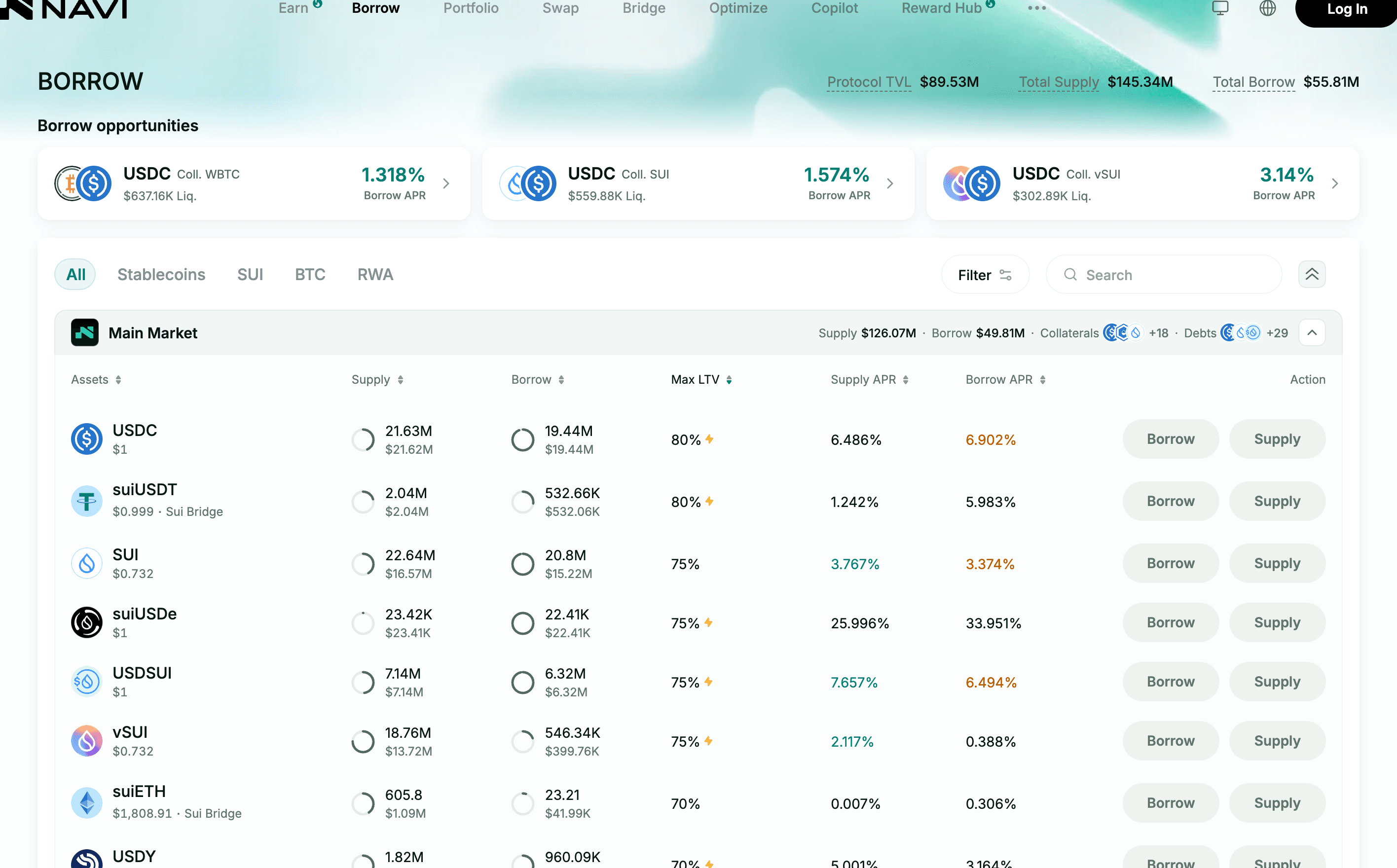
Open a position
Select collateral and a debt asset
Open 1-Click Borrow, choose collateral from your wallet and enter an amount. Select a supported debt asset. Review the matched market or choose another eligible pair.
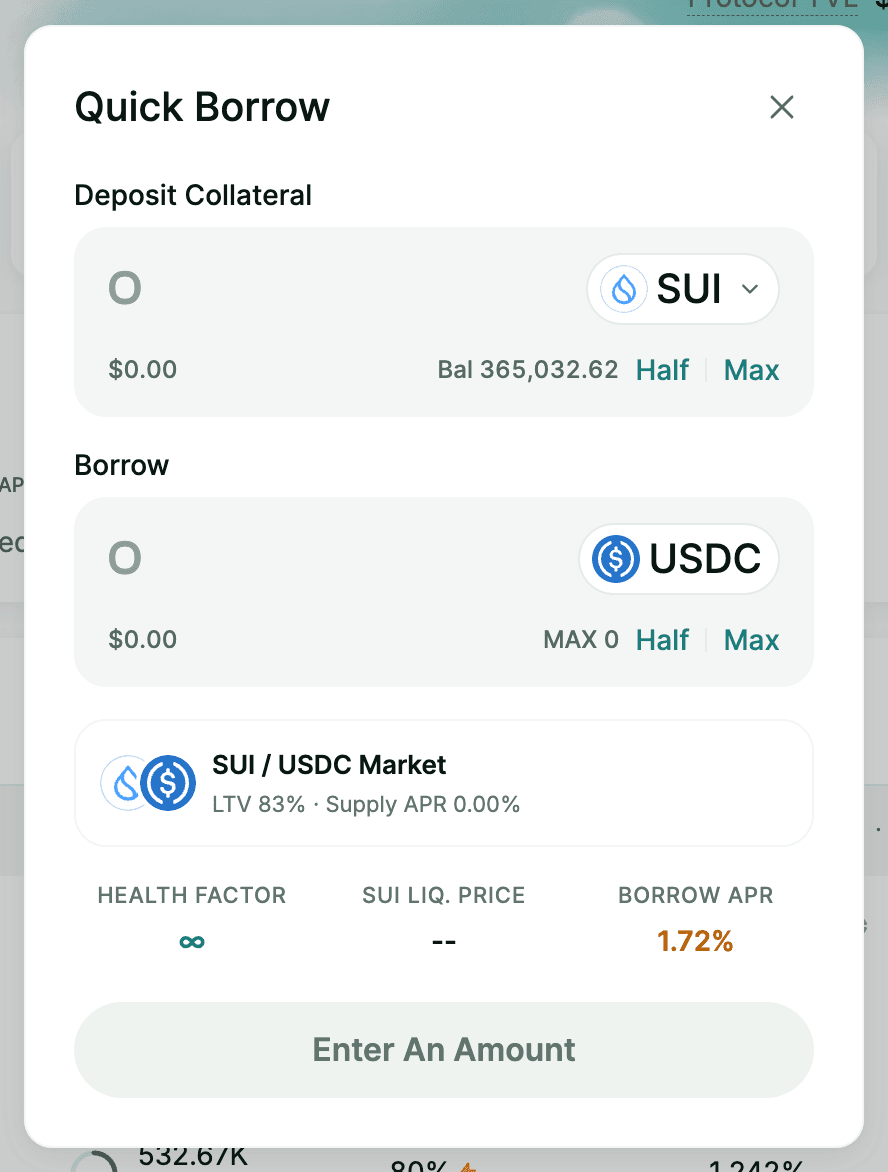
Check cost and liquidation risk
Check the upfront fee and borrow APR in the quote. As more of the reserve is borrowed, the interest rate model changes the rate on outstanding debt.
Use the maximum borrow calculation to check your limit. Review the projected Health Factor and liquidation price. If the new loan leaves little room above 1, reduce the amount and check the updated quote before signing.
Confirm and verify
Approve the transaction in your wallet. Once it settles, check the debt under your borrowed assets and the tokens received in your wallet.
Borrow more
If you already have collateral, select Borrow on the relevant asset row. Check the updated debt and projected Health Factor before confirming.
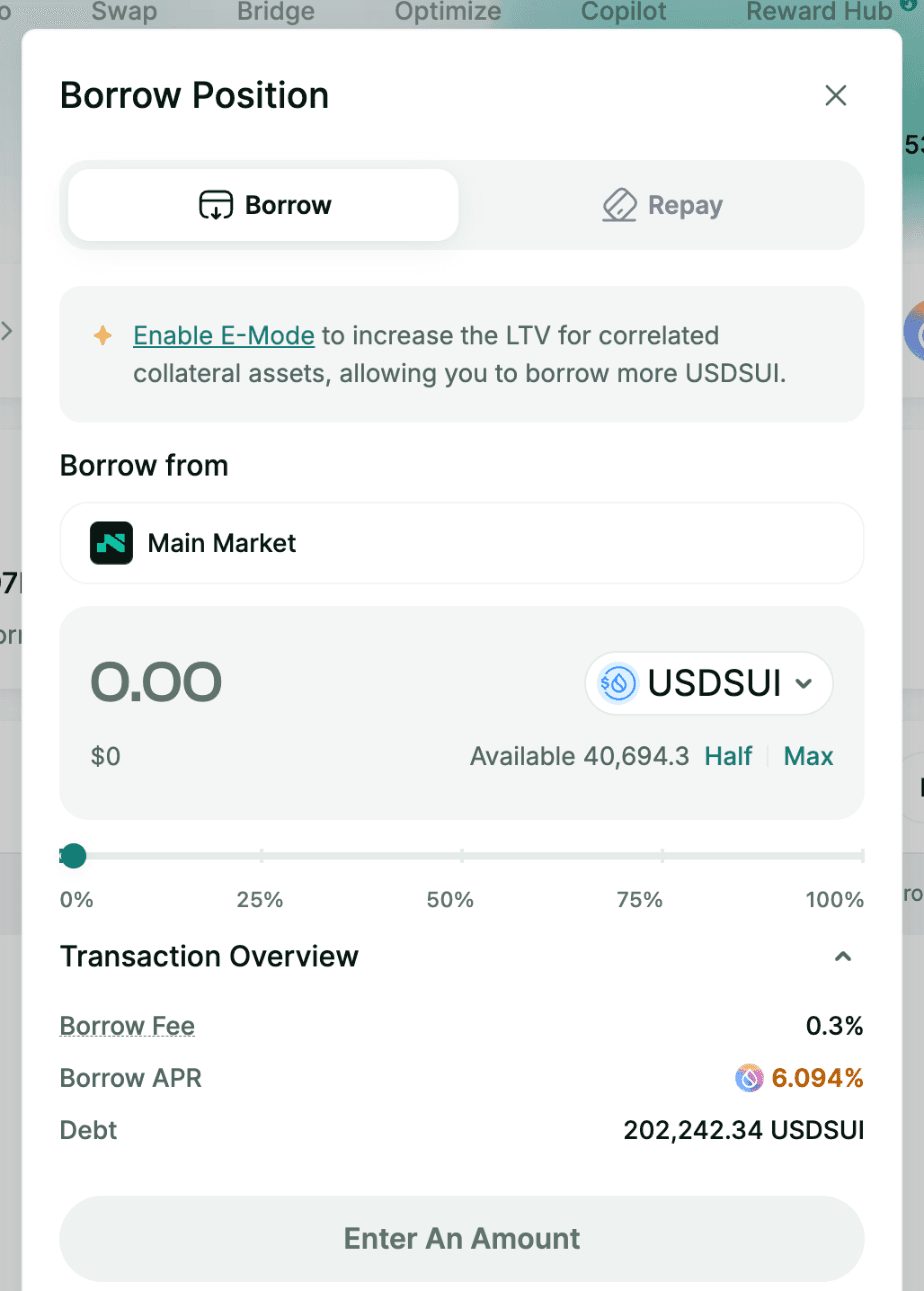
Using E-Mode
For eligible correlated pairs, the dialog offers Enable E-Mode. Confirm the mode change, then check the updated LTV before borrowing. Set up an E-Mode position.
Maximum borrow and minimum Health Factor
Use the collateral and debt from one market or E-Mode position. For each eligible collateral asset , take its current oracle value in USD (), maximum LTV () and liquidation threshold (). Use pair-specific parameters for E-Mode. The calculations below assume a borrow weight of 1.
How much more can I borrow?
The collateral supports up to dollars of total debt. Subtract the value of your outstanding debt , including accrued interest, to get the remaining borrowing power in dollars. For a debt token priced at dollars, the collateral-based token limit is .
What is the lowest Health Factor at that limit?
Let be the collateral value weighted by liquidation thresholds. At fixed prices and collateral balances, borrowing lowers the Health Factor as debt increases. When total debt reaches the full LTV limit , the minimum at that limit is
For a single collateral asset, this simplifies to . If , the collateral supports no new debt. Price moves and accrued interest can change the Health Factor after borrowing.
Example. Suppose you supply $800 of collateral at 75% LTV and an 80% threshold, plus $200 at 50% LTV and a 65% threshold. You already owe $300.
| Calculation | Result |
|---|---|
| Total debt limit | USD |
| Remaining borrowing power | USD, or 200 tokens at $2 each |
| Threshold-weighted collateral | USD |
| Health Factor at the full LTV limit |
Why can the app’s Max be lower?
The borrow quote also accounts for available liquidity, market limits, a Health Factor buffer, fees and token precision. If the transaction adds tokens of gross debt, its projected Health Factor is
In the example above, if the reserve can lend only 150 tokens at $2 each and the borrow fee is zero, the projected Health Factor is . Check the projected Health Factor in the confirmation dialog for your actual Max.
For a zero-fee quote, let be the number of debt tokens the reserve can lend now after liquidity, cap and rate-limit checks. The standard Borrow dialog applies a 1% margin to remaining LTV capacity and checks for a projected Health Factor of at least 1.04. Its token limits before rounding down are
In the example, and . With , Max is 150 tokens. Fees can reduce the amount received, and other borrowing flows can apply different buffers.
Monitor your Health Factor
Check the position in Borrow even when its token balances have barely changed. Falling collateral prices, a rise in the price of the asset you owe, or accruing interest can bring the Health Factor closer to 1. To check the prices used by the protocol, look up both assets in Oracle prices.
Maximum LTV limits new borrowing. The liquidation threshold determines how much of each collateral asset’s value counts toward the Health Factor. For example, with $100 in collateral at an 80% threshold and $50 of debt, the Health Factor is 1.6. Look up the thresholds by asset.
Use the same and as in the maximum borrow calculation. With outstanding debt, the current Health Factor and the position’s value-weighted liquidation threshold are
With zero debt, there is no finite Health Factor.
To increase the buffer, repay part of the debt or supply eligible collateral to the same position. Check its Health Factor again after the transaction.
If the Health Factor falls below 1
The position becomes eligible for liquidation. A liquidator can repay part of the debt and receive collateral worth the repayment plus the asset’s liquidation bonus. The close factor limits how much debt can be repaid per liquidation. A share of the bonus goes to the protocol treasury. Liquidation execution details.
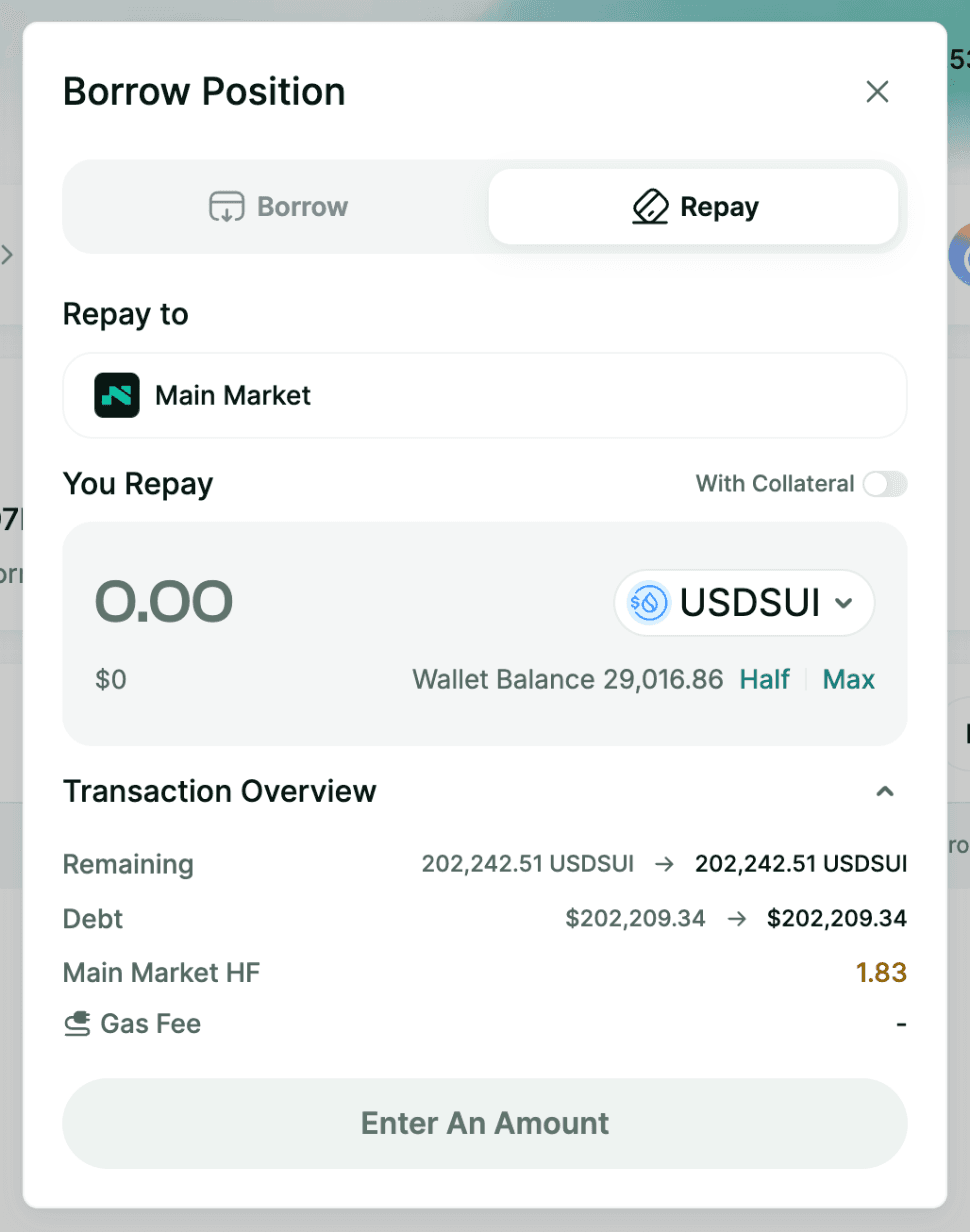
Repay
Open the debt in your portfolio and select Repay. Enter an amount in the borrowed asset, or select repayment using collateral where offered. Review the remaining debt and confirm. To close a loan, cover the accrued interest and verify the remaining debt is zero after settlement.
Common questions
Check the one-time borrow fee in the confirmation dialog. It is deducted from the amount you receive. Interest accrues on outstanding debt. Supplying and borrowing the same asset reduces the balance eligible for rewards. For example, equal supply and borrow amounts leave no net supplied liquidity for that asset.